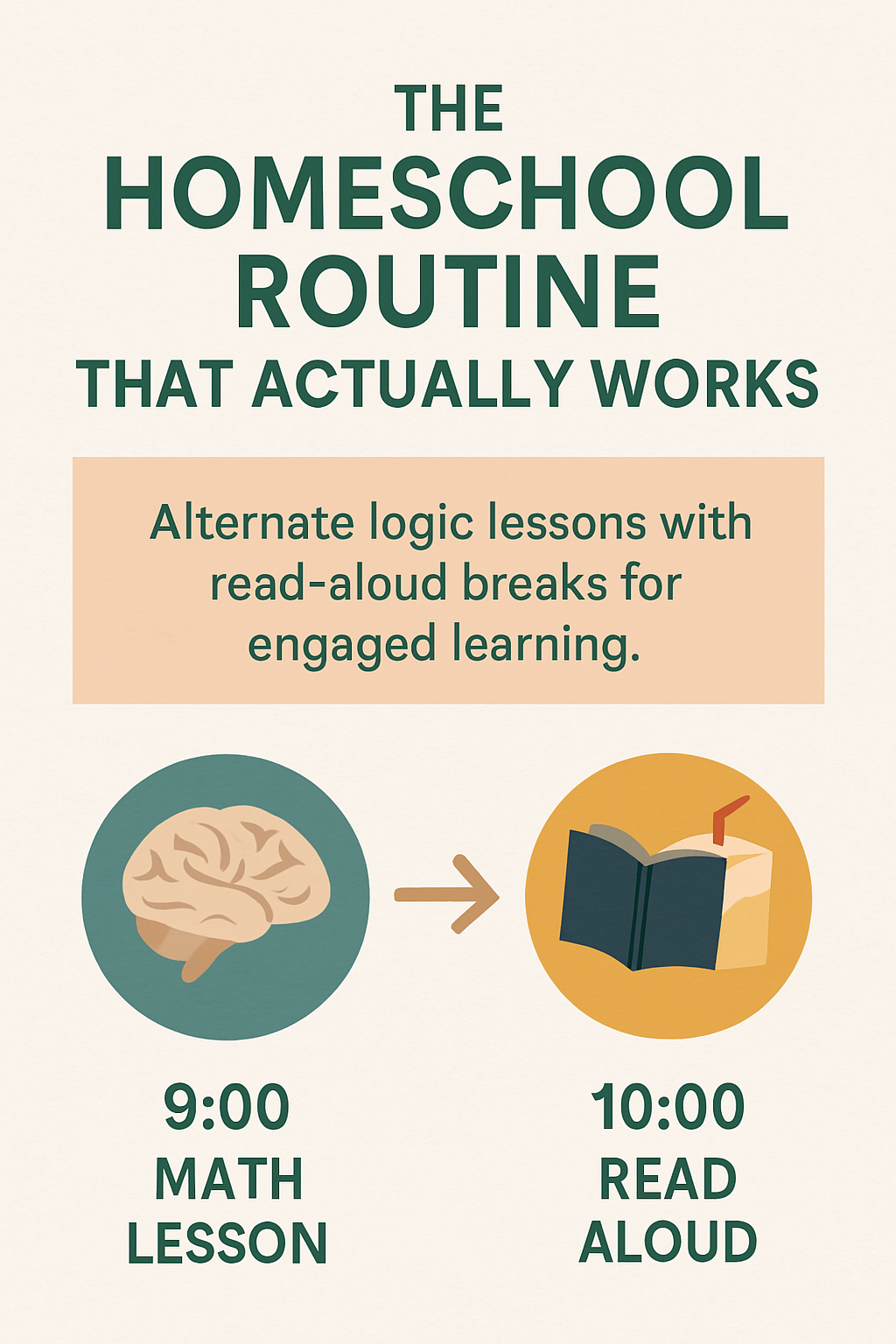
The Homeschool Routine That Actually Works for Better Focus, Memory & Joy Some homeschool days feel like a cozy rhythm. Others? Like wrangling gremlins while juggling grammar flashcards and gluten-free snacks. If your family struggles to stay engaged—or if you’re wondering how to teach what really matters without burnout—this twist on scheduling might help:A homeschool routine that actually works with how kids’ brains tick. We’ve built a flexible day around two brain modes: Focus + Think Listen + Absorb The result? More connection, fewer meltdowns, and a homeschool rhythm that supports deep learning and real-life joy. Start with Focus + Think Subjects These are your brain’s power-up subjects.They work best early in the day, when everyone’s fresh and fueled by pancakes or caffeine. Focus-heavy Subjects: Math Writing & grammar Science labs or documentation Critical thinking games Logic puzzles or challenge-based activities These subjects require problem-solving, decision-making, mental stamina, and output. They’re the backbone of any homeschool routine that actually works—but only when energy is high. We rotate our Focus blocks depending on energy and season—Grammar Galaxy is one of our favorites for language arts because it actually feels like a storytime adventure. Switch to Listen + Absorb Subjects After a Focus block, it’s time to absorb. These subjects still build learning—but they tap into imagination, memory, and curiosity with less mental friction. Absorb-friendly Subjects: History Literature Read-alouds Audiobooks or documentaries Faith, values, or character study Alternating between modes brings balance—and that’s the heart of a homeschool routine that actually works, even when attention spans wander or moods shift. We’ve also seen how learning styles shape focus blocks—this post breaks down our shift from frustration to function From Frustration to Focus.For a more curiosity-driven rhythm, see how we lean into unschooling principles during low-focus seasons- Trust, Curiosity, and Connection- This is What Unschooling Really Looks Like. How We Rotate All Day We alternate back and forth—keeping brains engaged without wearing them out. Here’s a real-life sample: Time Type Subject 9:00 AM Focus Math lesson 10:00 AM Absorb Read-aloud chapter (History) 10:30 AM Focus Creative writing & editing 11:15 AM Absorb Storytime with Snacks 12:00 PM Focus (light) Quick spelling or grammar 12:30 PM Absorb Independent audiobook time 1:00 PM Lunch + Free Play Reset for everyone What Do You Actually Need to Teach? Forget perfection. This isn’t about cramming in every Pinterest idea. It’s about showing up consistently for the subjects that matter—and curating extras that light your kids up. Core Subjects Math Reading & Literature Writing Science History or Social Studies Enrichment Subjects Foreign language PE or movement Handwriting Life skills (cooking, organizing, budgeting) Social Emotional Skills Art or music How Long Should Homeschool Take? There’s no one-size-fits-all answer. But here’s a guide to help build your own homeschool routine that actually works for your crew: Age Range Daily Time Weekly Goal Early Elementary 1.5–2.5 hours/day ~8–12 hours/week Upper Elementary 2.5–4 hours/day ~12–16 hours/week Middle School 4–5 hours/day ~18–22 hours/week High School 5–6 hours/day ~25–30 hours/week This includes breaks, enrichment, and rabbit trails—and keeps your homeschool routine that actually works from turning into an all-day power struggle. Tips to Make It Work for Real Life Start with a subject your child enjoys (confidence builds momentum). Use timers to signal transitions with less friction. Let conversations count—especially during absorb-mode subjects. Be okay with swapping subjects if energy shifts. You’re not failing—you’re adapting. A homeschool routine that actually works leaves room for flexibility, feelings, and the occasional pancake bribery. How Homeschool Routines Shift with the Seasons Even the homeschool routine that actually works might need a seasonal remix. Spring invites more spontaneous nature walks. Fall begs for cozy read-alouds. Summer might loosen the reins entirely. And winter? That’s when hot cocoa basically becomes a subject. Here’s how we gently adjust our schedule depending on the season: Spring Schedule More outdoor learning: nature journaling, science walks Shorter Focus blocks, longer movement breaks Fresh energy often means earlier starts Summer Schedule Lighter academic load (or full break!) Focus on life skills, travel, creativity Lots of Listen + Absorb moments: audiobooks, documentaries, summer reading Fall Schedule Return to structure with longer Focus blocks Cozy rhythms: poetry, history, warm drinks Ideal season for character studies and deep discussions Winter Schedule Later start times (because…blankets) More read-alouds, art, and slow science days Emphasis on warmth, connection, and rest-friendly learning The homeschool routine that actually works is the one that honors your family’s energy and embraces seasonal change—without guilt or rigid expectations. In summer, we lean into field trips. These Denver adventures became some of our favorite ‘unschooling’ days. Managing different ages in one homeschool day? This multi-level guide is a lifesaver.Need low-prep, absorb-mode activities that still spark joy? We love these play-based ideas. Our Homeschool Setup: Visual Rhythm Meets Real-Life Flexibility To help our homeschool routine that actually works stick, we use two visual tools that give structure without feeling rigid: Daily Schedule Chart (This one from Amazon)This colorful chart helps my kids know what’s coming next—whether it’s a Focus subject like math or a Listen + Absorb block like read-aloud time. Bonus: they love helping rearrange the schedule cards as our day evolves. Learning Calendar Wall Chart (This one here)We use this to anchor our morning routine. It’s perfect for building memory, noticing seasonal changes, and giving context to our shifting homeschool rhythm (especially with those seasonal tweaks I shared above). These visuals aren’t just pretty—they’re functional, empowering, and help build a rhythm my kids can take ownership of. Final Thought: Build a Rhythm That Feels Like Home Your homeschool doesn’t need to look like anyone else’s.But if your day starts feeling like a brain tug-of-war, alternating by brain mode might be the gentle reset you’ve needed.Teach with connection. Schedule with purpose.And never underestimate what a poetry break, trampoline bounce, or math victory can do for your homeschool routine that actually works. If you’re running on empty, this burnout checklist may feel a
How to Choose a Homeschool Language Arts Curriculum
How to Choose a Homeschool Language Arts Curriculum One of the most complicated subjects to plan—especially when you’re new to homeschooling—is your homeschool language arts curriculum. I had no idea how multifaceted it was until we dove in ourselves. Language arts isn’t just reading and writing. It’s a blend of five essential areas: reading skills, spelling, grammar, penmanship, and writing. And most curriculum options cover only a few of these pieces. Some shine in grammar but skim over spelling; others go deep into writing but skip penmanship altogether. So, let’s look at each component to help you build a well-rounded homeschool language arts curriculum that fits your child’s learning style and your teaching vibe. Quick Summary: How to Choose a Homeschool Language Arts Curriculum A complete homeschool language arts curriculum includes five key areas: reading, spelling, grammar, penmanship, and writing. Most programs cover only a few of these, so it’s common to mix and match based on your child’s needs and learning style. This guide breaks down popular curriculum options in each category and shows how to build a well-rounded plan that works for your family. What is a homeschool language arts curriculum? A homeschool language arts curriculum is a set of materials and lessons that teach children the five core components of language: reading, spelling, grammar, penmanship, and writing. Some programs cover all areas; others focus on just one or two. Reading: Primer vs. Orton-Gillingham (OG) Approach When exploring reading programs for your homeschool language arts curriculum, you’ll notice two common methods: Primer-Based Programs These are more traditional, focusing on word families, repetition, and simple phonics. They’re great for confident early readers or budget-friendly setups. Examples: Alpha Phonics Teach Your Child to Read in Easy Lessons Phonics Pathways Orton-Gillingham Inspired Programs These take a structured, multisensory path—ideal for kids who need extra support or struggle with decoding. Favorites for homeschoolers: All About Reading Logic of English Reading Horizons All About Reading stands out for being both methodical and fun. It spans from pre-reading through Level 4, which is about a 3rd-grade level—though that depends on your reader’s pace. Read about our experience with All About Reading here- From Tears to Triumph: Our All About Reading Journey. Spelling: Making Sense of All the Weird Rules Before homeschooling, I never realized how bizarre English spelling actually is. When crafting a homeschool language arts curriculum that includes spelling, the right program can make or break your child’s confidence. Here are a few popular options to explore: All About Spelling: A companion to All About Reading, with step-by-step rule-based lessons. Sequential Spelling: Focuses on patterns instead of strict rules—great for dyslexic learners. Spelling You See: A gentle, visual approach that weaves in copywork and context. I’ve learned so much by teaching these programs—things I was never taught in public school, like why “knight” starts with a silent “k”! Grammar: Making Sense of Sentence Structure No homeschool language arts curriculum feels complete without grammar. This section covers parts of speech, sentence structure, punctuation, and how language actually works. Great grammar options include: First Language Lessons (gentle, scripted, ideal for younger learners) Hake Grammar (rigorous and thorough) Voyages in English (classical, structured, and Catholic-friendly) Michael Clay Thompson (a high-level choice for advanced learners) Choose based on your child’s age and ability—but also your own comfort level. Do you want scripted lessons, diagramming practice, or open-ended discussion? Match your grammar choice to that. Do You Need Penmanship in Your Homeschool Curriculum? In today’s digital world, penmanship often gets overlooked—but including it in your homeschool language arts curriculum builds confidence, fine motor skills, and legibility. Top handwriting programs include: Handwriting without Tears: Easy to teach, developmentally appropriate. Zaner-Bloser: More traditional, with nice visual structure. The Good and the Beautiful Handwriting: Gentle and aesthetically pleasing. Many families rotate print, cursive, and copy work depending on their age group. Which Writing Program Fits Your Homeschool Language Arts Writing is the creative heartbeat of your homeschool language arts curriculum. It includes sentence structure, composition, critical thinking, and proofreading. You’ll also see overlap with grammar and spelling here. Favorites for homeschoolers: Writing with Ease or Writing with Skill by Susan Wise Bauer IEW (Institute for Excellence in Writing): Structured, with DVD lessons Brave Writer: Great for connection and creativity Write Shop: Balanced for reluctant writers and young learners Remember, writing takes time to grow. Even the best program needs flexibility and lots of encouragement! We like building in real-life projects like family recipe journaling or holiday story prompts to make it fun. I bought these Magnetic Notepads for our fridge and all of a sudden my kids are fighting over who can write the grocery list. Who knew magnetic notepads could spark a grocery list turf war? The kids are obsessed with jotting things down—finally, a fridge fight I don’t mind! What If Your Language Arts Program Doesn’t Cover Everything? Most programs won’t—and that’s okay. Use this post as a checklist to spot gaps and fill them in. For example: If your curriculum nails grammar and writing but lacks spelling, add Sequential Spelling. If you love your reading program but it doesn’t teach composition, layer in Writing With Ease. If your child resists penmanship, try a lighter option like Handwriting Without Tears for balance. Creating a homeschool language arts curriculum that fits your family is about customizing, not conforming. Mix and Match: Homeschool Language Arts Checklist Use this checklist to explore each core component, fill in gaps, and jot down your own curriculum picks. Looking for a printable version? Click here to download your checklist and build a curriculum plan that actually fits real-life learning. Multi-Subject Options That Work Well Looking for a full solution that blends multiple components? Here are a few programs that cover most of what you need—plus the emotional tone that keeps kids engaged. Logic of English: Rule-driven and comprehensive—great for logical learners and structured families Grammar Galaxy: Whimsical and story-based—perfect for families who want fun with fluency The Good and the Beautiful: Faith-based
The Truth About Homeschooling: What No One Tells You at First
The Truth About Homeschooling- Let’s be honest—the truth about homeschooling is that it’s exciting, terrifying, empowering, and overwhelming… all at once. If you’re weighing the decision, chances are you’re feeling a mix of hope and hesitation. The truth about homeschooling is, it doesn’t have to be perfect—it just has to work for your family. When I first became a mom, homeschooling wasn’t even a consideration. I worked part-time while my kids were little, and without realizing it, I was already doing the early groundwork: reading bedtime stories, exploring outside, answering curious questions. The truth is, learning happens all the time—whether we call it homeschooling or not. In those early days, I wasn’t homeschooling toddlers—I was simply trying to parent with intention and survive the snack chaos. I’d make a cup of Earl Grey Creme (that vanilla citrus swirl is magic) and catch quiet moments between ‘Why?’ questions and building blanket forts. Even then, learning was everywhere—in the questions, the play, the ordinary mess. Homeschooling starts long before you call it that. Debunking the Truth About Homeschooling Myths What held me back? The myth that homeschooling had to mimic public school at home—with rigid schedules and endless worksheets. And honestly? That idea scared me. Especially when I thought about teaching my autistic son in his early elementary years. But here’s the real truth about homeschooling: Kids are wired to learn—we just need to guide them, not micromanage them. Most days, my children naturally seek out learning. One might be struggling with reading but blazing through advanced math—and that’s okay. Homeschooling allows for that kind of flexibility and personalization. Related post: From Frustration to Focus: Using Learning Styles in Our Homeschool Why We Chose Homeschooling: The Real Truth Our decision was rooted in several factors, but a major one was peer influence. We noticed ongoing bullying and behavioral issues—and realized the truth about homeschooling is that you get to choose your child’s social circle and educational pace. Also? Freedom. If bugs are the topic of the day, we do bug-themed math, writing, and science If my kids are hungry to move, we bring in active learning tools and games We can take breaks when needed without “falling behind” Consider trying hands-on kits like
How to Make Money from Home While Homeschooling: 10 Flexible, Family-Friendly Ideas
How to Make Money from Home While Homeschooling: 10 Real-Life Ideas Homeschooling is a full-time commitment filled with messy snacks, sibling rotations, and unexpected discoveries. But what if you could make money from home while homeschooling—without sacrificing connection, creativity, or calm? Whether you’re looking to supplement your income, fund next season’s curriculum, or build something meaningful alongside your homeschool journey, these real-life strategies show that earning from home is absolutely possible. And yes—you can make money from homeschooling, simply by sharing what you already do best. Real Ways to Make Money from Home While Homeschooling: Teach English Online (No degree needed!) Open a cozy Shopify store—sell printables, snack guides & more Share your homeschool journey through blogging Sell printables, journals, or themed resources you already use Offer classes—ASL, nature journaling, or creative writing Resell gently used curriculum & books Freelance design or writing for fellow homeschoolers Start a podcast or YouTube channel with curriculum chats Host co-op classes, meetups, or “Swap & Sip” community events Palfish are beginner-friendly—no teaching background or Chinese fluency required. It was so much fun teaching these interactive classes, and Palfish provides all of the lesson planning for you! Just grab a TEFL or TESOL certificate from Bridge TEFL or Let’s TEFL, and you’re ready to start earning during quiet mornings or after the kids go to bed.
Top Gluten-Free Snacks for Kids That They Actually Love
Gluten-Free Snacks for Kids That Feel Like Home Real-life favorites from a homeschool mama who’s been packing safe, joyful gluten-free snacks for kids for years. Having gluten-free kids from the very beginning means we’ve danced down every aisle, googled every label, and taste-tested more than a few duds. Over time, we’ve found gluten-free snacks for kids that don’t just work—they belong in our rhythm. They make birthday parties less stressful, nature walks more magical, and regular days just a little easier. Here are our tried-and-true favorites with flavor suggestions and personal love notes sprinkled in: Hippeas Chickpea Snacks The crunch is amazing, the flavors are bold, and they somehow feel fun to eat.Our favorite gluten-free snacks for kids include: Vegan White Cheddar – my oldest says this tastes “like cheesy clouds” Blazin’ Hot – adds a zippy kick for spice-loving kids Bohemian Barbecue – smoky, snacky, and a park-day stapleThese puffs always end up in our bags for hiking or homeschooling on the go. YumEarth Treats My go-to for party swaps and snack moments where my kiddos need something safe and exciting.When it comes to gluten-free snacks for kids that bring joy, these top the list: Fruit Snacks – squishy and sweet, like a hug in a pouch Sour Giggles – the closest thing my kids have to sour Skittles Vitamin C Lollipops – perfect for lesson rewards or rainy day routinesThey’re dye-free and top-9 allergen-free, which means I can say “yes” more often. Siete Cinnamon Churro Strips These taste like a churro dream, without gluten or guilt.They’re one of the gluten-free snacks for kids that double as dessert—and they pair beautifully with hot cocoa and cozy reading. BEAR Real Fruit Snack Rolls Chewy, fruity, and full of curiosity.These gluten-free snacks for kids are quiet-time favorites and nature walk companions: Strawberry – sweet and simple, like a fruit roll-up without the mystery Raspberry – tangy and bold, perfect for snack swaps or lunchboxes Mango – tropical and fun, a sunny-day treat with zero added sugar Each pack includes a collectible animal card, which turns snack time into a mini adventure. Snyder’s Gluten-Free Pretzels Crisp, salty, and no one ever suspects they’re gluten-free.We rotate these reliable gluten-free snacks for kids through every season: Mini Pretzels for lunches Rods for dipping into peanut butter or hummus Hot Buffalo Wing Pieces for mama-only snacking Bobo’s Oat Muffins & Bites Soft, wholesome, and reliably delicious.Favorites that always make our gluten-free snack list: Apple Pie Stuff’d Bites – tastes like autumn in a single bite Chocolate Chip Bars – our go-to for homeschool hikes and car snacksMy kids ask for these before field trips and lake days—they feel like a “special treat” but still check our ingredient boxes. MadeGood Snacks Their bars and crispy squares have saved us during field trips and class celebrations.If you’re gathering gluten-free snacks for kids to share at events, these are game changers: Birthday Cake Drizzled Bars – always bring a smile Chocolate Chip Crispy Squares – easy “party tray” alternative Strawberry Granola Bites – great for lunchboxes or backyard learning daysThey sneak in veggie nutrients too, which feels like a parent win. Simple Mills Almond Flour Crackers Crunchy, flavorful, and addictive in all the good ways.Some of our favorite gluten-free snacks for kids that double as lesson tools: Farmhouse Cheddar – tastes like Cheez-Its but without the mystery ingredients Rosemary & Sea Salt – fancy enough for grown-up cheese boardsWe’ve even used them as math manipulatives—snack and school, all in one! PopCorners Popped Chips Light and airy with real flavor.These gluten-free snacks for kids are movie night staples: Sweet Chili – sweet, spicy, and totally snack-worthy White Cheddar – a favorite during homeschool movie days Cinnamon Crunch – good for snacking AND counting during math practice Where These Snacks Really Shine Most of the snacks on this list aren’t just for quiet days or lunchboxes—they’ve saved us during field trips, park days, and, yes… birthday parties. If you’re staring down a class celebration or surprise invite and wondering what your gluten-free kid can safely eat (and love), don’t miss my companion guide: The Ultimate Guide to Gluten-Free Snacks for Kids’ Parties It’s packed with: Freezer-friendly cupcake hacks Safe candy and crispy bars for party tables Easy, inclusive DIY treat stations Snack storage tips, emotional encouragement, and even a few mama-tear moments Because showing up prepared doesn’t just keep your child safe—it helps them feel seen and included. A Note from Our Kitchen to Yours Snack time isn’t just about food—it’s about inclusion, routine, and that tiny exhale when everyone feels safe and seen. These gluten-free snacks for kids help us show up for our little ones with joy and ease, even when the rest of the party table says “no thanks.” If your family’s navigating gluten-free life, I hope this list wraps you in possibility and peace
How to Teach Multiple Grade Levels in Your Homeschool: Practical Tips for Real Moms
Can You Homeschool in Small Spaces with Multiple Grade Levels? Here’s What Worked for Us When I first started homeschooling, I had this dreamy vision: both kids sitting quietly at the table, working through their lessons while I floated between them like a calm, caffeinated fairy. Reality? Not so much. We live in a small space, and trying to teach two kids at different grade levels quickly turned into a chaotic game of “Let’s see how loud we can be while Mom’s helping my sibling.” Add in a husband who works night shifts and needs to sleep during the day, and I knew something had to change. Quick Summary: How We Homeschool Multiple Grade Levels in a Small Space Use free indoor playgrounds to rotate teaching time Pack a homeschool travel bag with essential learning tools Modify curriculum like Grammar Galaxy for multi-age use Include play, audio, and one-room schoolhouse strategies Can Church Playgrounds Support Small-Space Homeschooling? That’s when I discovered a hidden gem in our town—local churches with indoor playgrounds. And no, you don’t have to attend services to use them. These spaces are open, welcoming, and often come with a bonus: a cozy little coffee shop for that much-needed caffeine fix. There are two churches near us that offer indoor play areas. While they’re not fancy, they’re perfect. The kids get to run, climb, and socialize, and I get a quiet(ish) corner to teach one-on-one. Coming soon: How to Find Free Indoor Play Spaces in Your City What do I pack for mobile homeschooling? Whether we’re heading to a church play area, a museum, or a spontaneous park day, I always bring my homeschool travel bag. It’s my mobile classroom, creativity kit, and sanity-saver. Here’s what I pack: Item Why I Love It Link Kid-sized whiteboards Great for quick lessons, spelling practice, and math visuals Amazon Math linking blocks Perfect for hands-on math and skip counting Amazon Pop-It multiplication table Tactile, fun, and surprisingly effective for memorization Amazon Pencil case with pencils, markers, scissors, and letter tiles Everything we need for writing, spelling, and creative play Amazon Water bottle Because hydration is non-negotiable Amazon Weekender tote Spacious, durable, and easy to carry Amazon Whether we’re at a church playground or chasing butterflies at the park, snacks are non-negotiable. Here’s our go-to list of Top Gluten-Free Snacks That Kids Actually Love– real favorites, not just shelf-fillers. How Do You Manage Teaching Multiple Grade Levels in One Room? Here’s the part that makes other moms go, “Wait… why didn’t I think of that?” I set up at a table near the playground. One child plays while I work with the other. Then we switch. It’s a simple rotation, but it works beautifully. No distractions. No sibling sabotage. Just focused time with each child—and a latte in hand. Can You Teach Different Grade Levels at the Same Time? While some subjects need to be taught separately, I’ve found that teaching together—even with different grade levels—can be incredibly effective. For example, in social studies, my third grader helps read the text aloud while my first grader listens. We pause to discuss, and I love hearing them explain things to each other in their own words. We are using Grammar Galaxy for language arts to use for both kids. It’s designed to be flexible across grade levels, with story-based lessons and missions that make grammar feel like an adventure. It’s perfect for multi-age learning and easy to modify. We’ve learning that understanding each child’s learning style makes all the difference- especially when teaching side by side. If you’re navigating different needs and personalities, this post might help: From Frustration to Focus: Using Learning Styles in Our Homeschool P.S. Every learner’s different—especially in a multi-grade homeschool. One of our kids needs something with more structure and logic, so we are also incorporating Logic of English. Its rule-based approach and multisensory lessons were a great fit for our autistic, analytical learner. If Grammar Galaxy is our storytelling spark, Logic of English is our decoder ring—and they complement each other beautifully. Explore Logic of English here Where MEL Science Fits In On days when we’re not at the church, we dive into hands-on science at home. MEL Science has been a game-changer for us. Their monthly kits include everything you need for immersive experiments—no prep, no stress. We especially love their electricity and chemistry sets. They’re perfect for curious learners who want to see science in action. MEL Science is ideal for homeschoolers who want to make STEM feel magical—and manageable. Bonus Tips for Teaching Multiple Grade Levels Once I figured out the playground rotation trick, I started picking up even more simple strategies that make multi-level teaching way easier. Here are a few that have saved my sanity: Morning Basket Moments – Start your day with shared reading, poetry, memory work, or a devotional. It creates connection and calm. One-Room Schoolhouse Strategy – Choose a topic (like weather or pioneers) and let each child engage at their own level—drawing for one, writing for the other. Use Audio as a Helper – Let one child listen to audiobooks or podcasts while you teach the other. It’s quiet and productive! Teach Once, Tweak as Needed – Flexible curriculums like Grammar Galaxy or MEL Science make it easy to adapt the same lesson for different skill levels. Curriculum That Fits Small Spaces and Big Curiosity If you’re teaching in tight quarters with kids at different levels, Pandia Press offers flexible, secular curriculum that adapts beautifully to your homeschool rhythm. Their History Quest series is story-driven and cozy—perfect for shared read-alouds and snuggly history hops. And Real Science Odyssey turns your kitchen table into a lab, with experiments and journaling prompts that work for multiple ages. Why We Love It: Designed for multi-age families Hands-on, narrative-rich, and easy to adapt Perfect for small spaces and big imaginations Explore Pandia Press Curriculum Whether you’re rotating kids at a church playground or teaching side-by-side at
Trust, Curiosity, and Connection—This Is What Unschooling Really Looks Like
If you’ve ever felt like your homeschool days are more about checking boxes than nurturing curiosity, you’re not alone. Many families—ours included—have found that unschooling offers a refreshing alternative: one that prioritizes connection, creativity, and trust over rigid schedules and curriculum fatigue. But what does unschooling really look like? And how do you know if it’s right for your family? Let’s explore the heart of unschooling, how it shows up in everyday life, and gentle ways to incorporate it—without tossing everything you’ve built. Quick Summary: What Is Unschooling? – Child-led learning driven by curiosity and connection – Focuses on real-life experiences instead of worksheets – Encourages flexible routines, hands-on exploration, and relationship-building – Works beautifully across ages and learning styles What Is Unschooling? Unschooling is a form of child-led learning that trusts kids to follow their interests, ask questions, and explore the world in ways that feel meaningful to them. It’s not “no schooling”—it’s life as learning. Instead of worksheets and lesson plans, unschooling invites: Nature walks that spark science conversations Baking that turns into math and chemistry Minecraft builds that lead to architecture and storytelling Deep dives into dinosaurs, space, or poetry—because your child wants to know more It’s flexible, responsive, and deeply personal. What Are the Benefits of Unschooling? Unschooling isn’t just a philosophy—it’s a lifestyle shift that can transform your homeschool experience. Here’s what we’ve noticed: 1. Deeper Engagement Kids learn more when they care. Unschooling taps into intrinsic motivation, which leads to longer-lasting understanding. 2. Less Stress, More Joy No more battles over worksheets or tears over spelling lists. Learning becomes a shared adventure, not a power struggle. 3. Personalized Learning Paths Whether your child is obsessed with bugs, baking, or ballet, unschooling lets them go deep—without waiting for a unit study to catch up. 4. Stronger Family Connection When learning happens through conversation, play, and shared experiences, relationships flourish. Related post: 10 Homeschool Burnout Signs You Shouldn’t Ignore—And What to Do Instead How Does Unschooling Work Day-to-Day? Here’s a peek into our unschooling rhythm—no two days are the same, and that’s the beauty of it. – Morning: My daughter curls up with her art journal, sketching the geese and their fuzzy goslings we saw at the lake earlier this week. We looked up their species in a wetland wildlife guide and chatted about migration, parental behaviors, and how goslings learn to swim. – Midday: My son spreads out his circuit board kit on the kitchen table, experimenting with switches and motors. He’s captivated by electricity—so we dive into a video on how current flows, then test ideas using clip leads and a mini-LED fan. Later, we open our latest MEL Science kit– this month’s experiment explores conductivity and circuits. He’s thrilled to build something “real,” and I love how it deepens his understanding without feeling like a lesson. – Evening: We wind down with a documentary about penguins. The kids ask about migration routes, colony behavior, and how penguins care for their young. We end up drawing a life cycle chart and talking about the similarities between penguin and goose families. And when the questions get delightfully weird- like “Could a penguin live in our backyard? We turn to Dr. Binocs on Peekaboo Kidz. His animated science videos are playful clear, and perfect for curious minds. No curriculum. Just connection, curiosity, and a whole lot of learning through living. And if your kids love storytelling as much as science, Honest History Magazine brings the past to life with beautifully illustrated, narrative-rich issues. From daring inventors to global adventures, it’s the kind of history that feels like play. We just started using it in our unschooling days, and it’s sparked some of our best kitchen-table questions yet. Use code PRAIRIE10 for 10% off your first issue. Amazon Picks That Naturally Support Unschooling Item Why We Love It Link Bird Watching Journal for Kids Encourages observation, sketching, and note-taking Shop here Art Journal & Sketch Set Inspires observation, creativity, and reflection—ideal for drawing animals and habitats Shop here Circuit Board Kit for Kids Hands-on way to explore electricity, circuits, and STEM—great for curious tinkerers Shop here Mini Clip Leads & LED Fan Pack Simple tools that make basic experiments fun and accessible for little engineers Shop here Penguin Documentary DVD / Streaming Options Engaging visuals and facts about animal habits, migration, and family systems Shop here Life Cycle Chart Templates or Laminated Posters Helps children visualize animal development through drawing or discussion Shop here Binoculars for Kids Encourages outdoor observation—great for lakeside walks and spotting bird behavior Shop here Nature Notebook with Prompts Supports reflection and documentation of daily discoveries and questions Shop here How Can I Start Unschooling Without Overhauling Everything? You don’t have to go all-in overnight. Here are gentle ways to begin: 1. Follow Their Questions If your child asks, “Why do leaves change color?”—pause and explore. Look it up together. Watch a video. Collect leaves. That’s science. 2. Create a Resource-Rich Environment Stock your home with books, games, art supplies, and tools that invite exploration. Think microscopes, magnifying glasses, and story cubes. 3. Let Go of the Timeline Learning isn’t linear. Trust that your child will circle back to skills when they’re ready—and that joy is a valid learning outcome. 4. Keep a Learning Journal Instead of grades, jot down what your child explores each week. You’ll be amazed at how much learning happens when you’re not looking for it. Can Moms Benefit from Unschooling, Too? Unschooling isn’t just for kids- it’s for us too. When the day feels heavy or the questions keep coming, I’ve learned to pause, breathe, and steep something that feels like forest calm. Chaga Chai Mushroom Tea from Art of Tea is grounding and spicy, with warming notes of cinnamon and clove and the earthy hug of adaptogenic chaga.It reminds me that learning doesn’t have to be loud—and rest isn’t wasted time. This is my go-to when unschooling needs a deep breath,
10 Signs of Homeschool Burnout (It’s Not About the Curriculum)
10 Signs Your Child Needs a Homeschool Break (And What to Do About It) Is homeschooling starting to feel like a daily battle? How can you tell if your child is overwhelmed—not just unmotivated? If your homeschool days feel more like a tug-of-war than a joyful journey, you’re not alone. Especially after transitioning from public school, many families experience unexpected resistance—kids disengaging, tensions rising, and a once-exciting homeschool plan suddenly feeling heavy. That was us. We expected a smooth shift into personalized learning—but instead, we hit a wall of burnout. Even simple lessons triggered frustration. Our kids dreaded schoolwork, and we started second-guessing everything: our curriculum, our schedule, even our decision to homeschool. So, we paused.We stepped back—not to buy new materials, but to reconnect. We leaned into unschooling, a gentler rhythm that emphasized play, curiosity, and meaningful moments. Slowly, the resistance softened. Our kids rediscovered joy. Learning became something they leaned into—not something they avoided. We didn’t buy new materials—but I did refill my mug.White Coconut Crème from Art of Tea became my homeschool reset ritual. The creamy coconut and soft vanilla notes felt like a tropical exhale—reminding me to slow down, connect, and savor tiny moments of peace between the chaos.Need your own breath of calm? This is my go-to tea during burnout breaks: Coconut Creme Tea. Before you overhaul your homeschool plan, consider this: your child may need rest and rhythm—not another workbook. Let’s explore 10 gentle signs that your child is craving connection—and how to respond with care. Quick Summary: Signs Your Child Might Need a Homeschool Break – Resistance to favorite subjects – Emotional outbursts over simple tasks – Frequent daydreaming or lack of focus – Sleep issues and low energy – Loss of joy, connection, and curiosity 1. Why Is My Child Suddenly Resisting Homeschooling? If your child suddenly groans at the sight of their favorite subject, it’s a red flag. Resistance often signals mental fatigue, not a curriculum mismatch. Try: A week of interest-led learning or a nature walk with this kid-friendly field journal to reset their mindset. 2. Emotional Outbursts Over Simple Tasks Tears over math facts or spelling lists? That’s not laziness—it’s overwhelm. Emotional dysregulation often means your child’s executive function is maxed out. Related read: How We Use Ember Bucks to Teach Emotional Regulation 3. Frequent Daydreaming or Zoning Out Spacing out during lessons isn’t always boredom—it can be a sign of cognitive overload. Their brain might be begging for downtime. Try: Quiet time with a sensory fidget set or a calming audiobook. 4. Forgetfulness and Lack of Focus If your child is forgetting instructions or skipping steps, it may not be a discipline issue—it could be mental fatigue. Tip: Use dry-erase pockets for low-pressure review games that feel playful, not punishing. 5. Is My Child Burnt Out on Homeschooling? When your child stops lighting up during science experiments or story time, it’s time to pause. Burnout can dull even their brightest interests. Try: A week of unschooling-inspired exploration with Dino Detective Printables or a library scavenger hunt. 6. Can Homeschool Stress Affect Sleep? Sleep disruptions often follow over-scheduling or emotional stress. If your child is dragging in the morning, it’s time to slow down. Try: A cozy bedtime routine with this weighted blanket and a calming read-aloud. P.S. During our own burnout phase, I started swapping out harsh cleaning products and synthetic fragrances for gentler alternatives. Grove Collaborative became my go-to for honest essentials—like non-toxic room sprays and biodegradable laundry sheets. Honest Company’s lavender bubble bath also turned into part of our nighttime rhythm—a warm soak for sensory reset that even I started looking forward to. 7.Withdrawing from Siblings or Friends Social withdrawal can be a sign your child feels emotionally depleted. They may need connection more than correction. Related post: How Our Homeschool Co-op Helped Us Reconnect 8. Constant Requests to Change Curriculum If your child keeps asking to “try something new,” they may be chasing novelty to escape burnout—not seeking better content. Tip: Offer a mini break with creative writing prompts or a DIY learning menu. 9.Complaints of Headaches or Stomachaches Physical symptoms can be your child’s way of saying, “I need rest.” Stress often shows up in the body before the brain catches on.Try: A hydration station with fun reusable water bottles and a quiet reading nook. 10. You’re Feeling Burnt Out Too If you’re tired, snappy, or second-guessing everything—you’re not failing. You’re human. And your child may be mirroring your energy. Related post: From Burnout to Belonging: Our Move to North Dakota When We Were Ready to Rebuild After our homeschool pause, we didn’t jump back in with rigid schedules or heavy workbooks. We chose tools that felt flexible, supportive, and aligned with how our kids actually learn. One of those was Logic of English. It’s a pick-up-and-teach phonics program that helped our logical autistic learner feel safe and confident again—with consistent rules, multisensory lessons, and a clear structure that made reading feel less like a battle and more like a puzzle they could solve. If you’re easing back into learning after burnout, Logic of English might be the gentle clarity your homeschool needs. Favorite Tools for Gentle Homeschool Breaks Here are a few Amazon picks that help us reset without ditching our curriculum: Reusable, low pressure practice Dry Erase Pockets A gentle yet fun Nature Activity Book to learn organically in nature A Weighted Blanket for comfort- they’re actually very soothing! If it’s warm out, my kids can spend hours playing with a Water Table Mel Science Kits- lots of learning and lots of fun too! Curious about unschooling? It’s not about giving up—it’s about tuning in. Taking that step back helped our family rediscover joy in learning. If you’re feeling burnt out, you might find healing (and freedom) in embracing a season of unschooling. To learn more about unschooling, read my post: Trust, Curiosity, and Connection: This is What Unschooling Really Looks Like. Training Aliens:
Hands-On Learning at Home: 7 Play-Based Activities Kids Love
Play isn’t a break from learning- it is learning. Especially for families embracing hands-on learning at home, these activities nurture deep understanding, emotional resilience, and joyful curiosity. Whether you’re homeschooling full time or simply infusing creativity into everyday routines, these 7 activities actually work—and they’re easy to adapt for diverse ages, learning styles, and small spaces. Unlike many “just keep them busy” lists, everything here ties back to real learning goals, without sacrificing fun. 1. Story Stones for Creative Narration & Language Development How it works:Paint or draw simple images (a tree, a dragon, a backpack) on small stones or wood discs. Prompt your child to pull three and weave a story around them. Why it works: Boosts oral language, sequencing, and creativity Especially effective for reluctant writers—turns talking into storytelling Can double as a quiet-time activity for siblings Try this:For materials, check out the MindWare Paint Your Own Story Stones Kits or Smooth Craft Stones—ideal for creating your own set. 2. Hands-On Math Confidence: Dramatic Play Cash Register How it works:Set up a home “shop” with items labeled in prices. Add play money and a DIY cash register made from cardboard or a calculator. Children take turns shopping and making change. Why it works: Builds number sense, addition, and subtraction Encourages real-life math conversations Great for multi-age groups—older kids can roleplay bank tellers or create store signs Bonus idea:Use actual pantry items for a grocery theme. Link it to real budgeting lessons or cooking prep! Make it magical:Download our free printable Ember Bucks to use in your shop setup—they add a cozy touch of Prairie Ember flair while giving your kids tangible math practice. Just print, cut, and start spending! Try this: Pair your Ember Bucks with the Learning Resources Pretend & Play Cash Register for added interaction and durability. 3. Hands on Science Fun: Water Lab Station Fill containers with water, food coloring, droppers, funnels, and “mystery ingredients” like baking soda or cornstarch. Invite free exploration. Why it works: Encourages observation, hypothesis-making, and sensory exploration Turns kitchen chaos into scientific inquiry Naturally lends itself to journaling or sketching what they discover Extend the learning:Grab the Splashology Water Lab Kit—perfect for messy science play at home or grab a Mel Science Kit for super science fun! 4. Laundry Basket Geography Game How it works:Tape country/state names or flags to laundry baskets. Call out trivia or clues, and kids toss a beanbag into the matching basket. Why it works: Reinforces location-based learning through kinesthetic movement Great for review games or unit wrap-ups Easily adapted to spelling, math facts, or language learning Link it up:Try the Skillmatics Guess in 10: States of America or Race Across the USA Board Game build foundational geography knowledge. 5. Sensory Build & Tell: Hands-On Construction for Storytelling How it works:Fill a bin with tactile materials—playdough, blocks, pipe cleaners, pebbles. Ask kids to build something that matches a prompt (“build a cozy animal habitat”) and then explain it. Why it works: Supports engineering and spatial reasoning Encourages expressive language and presentation skills Fantastic for mixed-age siblings working at their own level Homeschool tie-in:Use materials like the National Geographic Sensory Science Kit or Pipe Cleaner Craft Set to stock your bins with hands-on magic. 6. Nature Scavenger Hike with Embedded Learning Prompts How it works:Design a scavenger hunt with prompts like “find something softer than your shirt” or “locate a plant with jagged leaves.” Add notebooks or sketchpads for recording. Why it works: Deepens observation and comparison skills Builds descriptive vocabulary Connects science to personal experience Make it your own:Check out this Nature Scavenger Kit—complete with magnifying glasses, bags, and cards—or the Craft-Tastic Scavenger Hunt Potions Kit for a magical twist. 7. Feelings Theater for Emotional Literacy How it works:Grab stuffed animals or puppets. Act out scenarios: “Bear is feeling nervous about trying something new. What happens next?” Invite kids to narrate or improvise responses. Why it works: Supports SEL (social-emotional learning) through roleplay Gives space for kids to externalize and process tricky feelings Encourages empathy and collaborative storytelling Extension idea:Try the Melissa and Doug Hand Puppet Set and the Melissa and Doug Hand Puppet Theater to create a storytelling space that invites expression. Curriculum That Feels Like Play—But Teaches Deeply If your kids thrive with storytelling, sensory play, and curiosity-led learning, Pandia Press offers history and science programs that feel like an extension of your homeschool rhythm. Their History Quest series is packed with narrative read-alouds, map work, and “Hygge History” weeks—perfect for cozy learners who love snuggling up with stories. And Real Science Odyssey turns everyday wonder into structured exploration, with experiments and journaling prompts that feel like play but build real understanding. Why We Love It: Secular, flexible, and multi-age friendly Designed for hands-on, heart-forward families Encourages deep learning through storytelling and tactile engagement Explore Pandia Press Curriculum It’s one of our favorite ways to keep learning playful—and purposeful. Final Thoughts Play-based learning isn’t a replacement for structured curriculum—it’s a rhythm that invites curiosity, connection, and joy. These activities aren’t just Pinterest-perfect ideas; they’re field-tested in our homeschool and designed to spark real learning, even in pajamas and snack-strewn living rooms. After the messy magic of learning through play, we lean into routines that soothe and reset. Grove’s low-tox sprays and Honest’s gentle skin care let us clean up and wind down—without the sensory overwhelm. It’s all part of keeping our homeschool joyfully sustainable. If your family loves learning through story as much as play, we’re obsessed with Honest History Magazine. Its beautifully illustrated, curiosity-driven issues make history feel like an adventure, not a lecture. We tuck it into quiet-time baskets, road trip bags, and nature nook shelves. Use code PRAIRIE10 to save 10%—your homeschool deserves story-powered wonder. Want more child-led ideas?Explore our guide to Homeschool Hacks or browse our free printable collection to support hands-on learning at every stage. Let’s keep learning playful—and personal. 🔬 What Is MEL Science? MEL Science is a hands-on science subscription that turns your kids into
From Frustration to Focus: Using Learning Styles in Our Homeschool
What Is Teaching by Learning Style in Homeschooling? Teaching by learning style means recognizing that kids absorb information differently—some thrive with visuals, others through sound, and many by moving or doing. When you match your teaching method to your child’s learning style, education shifts from stressful to joyful. Whether your child struggles with workbooks or tunes out during read-alouds, understanding their unique learning styles might be the game-changer your homeschool needs. The Game-Changer: Teaching by Learning Style Instead of pushing through methods that weren’t working, I paused and paid close attention to how my kids naturally learn. What lit them up? What helped information really stick? That’s when I started teaching by learning style. I added: Math manipulatives Hands-on games Catchy songs tied to core concepts The change was immediate. Not only did they grasp ideas faster—they actually enjoyed learning. What Are Learning Styles? At the heart of teaching by learning style is understanding that kids (and adults!) absorb information differently. Here are the three primary learning styles: Visual Learners – Thrive with images, charts, diagrams, and videos Auditory Learners – Learn best through listening, discussions, and storytelling Kinesthetic Learners – Need to move, build, and interact physically Some children blend these styles, and observation becomes your superpower. Why Does Teaching by Learning Style Work? Less resistance to lessons More engagement and faster understanding Easier adaptation of curriculum and activities Boosts confidence and connection Example: When I swapped worksheets for math manipulatives, my kinesthetic learner went from overwhelmed to excited. What Are the 3 Main Learning Styles? Learning Style How They Learn Best Examples Visual Seeing charts, diagrams, images, videos Flashcards, illustrated books Auditory Hearing discussions, music, storytelling Read-alouds, catchy songs Kinesthetic Moving, touching, building Experiments, games, manipulatives Many kids use a blend of styles. Observing what excites them during play and learning will guide you. How Did Learning Styles Change Our Homeschool? Before: Workbook-heavy routines led to stress and disengagementAfter: I added movement-based math games, songs, and visual toolsResult: My kids didn’t just memorize—they understood All About Reading helped my tactile learner thrive where standard phonics fell flat. That mindset also transformed our reading approach. When I noticed how tactile activities made my daughter come alive, we switched to All About Reading. It met her kinesthetic needs beautifully and built her confidence, step by step. You can read about that journey here- From Tears to Triumph: Our All About Reading Journey. Quick Quiz: What’s Your Child’s Learning Style? Answer these to find out what fits your child best: How do they prefer to learn something new? A. Watch a demo B. Hear instructions C. Try it hands-on During storytime they… A. Focus on pictures B. Love dramatic voices C. Act out the story They solve problems by… A. Drawing B. Talking it through C. Using physical objects They remember by… A. Seeing/writing B. Singing/speaking C. Doing/moving Mostly A’s → Visual Mostly B’s → Auditory Mostly C’s → Kinesthetic Curriculum Picks by Learning Style Whether you’re just starting or refining your homeschool, these tools make teaching by learning style simple and effective: Visual Learners Math-U-See blocks All About Reading / Spelling Grammar Galaxy Math Mammoth Auditory Learners Life of Fred series Sing Song Latin / Whistlefritz Spanish Torchlight Curriculum Kinesthetic Learners Explode the Code workbooks Real Science Odyssey experiments Mel Science Kits Handwriting without Tears Why Logic of English Made Reading Finally Click When phonics felt like a guessing game, we needed a fresh start. Logic of English gave us just that—with tools that actually fit how each of our kids learn. Visual learners love the color-coded charts and spelling patterns Auditory learners thrive on phonogram chants and dictation practice Kinesthetic learners stay engaged through handwriting strokes and movement-based games Logical thinkers—including autistic learners—benefit from the clear rules and consistent structure For our logical autistic learner, it was a game-changer. The predictable patterns, rule-based explanations, and step-by-step approach helped reading feel less chaotic and more like solving a puzzle—and that’s when the confidence started to grow. If your homeschool needs phonics with clarity, flexibility, and a little joy… Logic of English might be the shift you’ve been waiting for. My Favorite Resources for Teaching by Learning Style These awesome linking math cubes that double as construction toys! This fun human body kit where you get to poke around on your insides! A magnetic U.S. map, this has been so fun for learning the states, and the kids love quizzing each other with it. These basic kid sized white boards have been amazing for showing concepts. This math white board is a great visual number line that kids can use to do their math problems on. We’ve had this human body busy book for years and my kids still love playing with it. This pancake game was a hit for a long time at our house; it helps teach coordination and number pattern. We’ve loved this hands-on book about learning to identify emotions and how we can work through them. The Fidget Game is so fun for learning sight words! The Fly Swatter Game is also a hoot for identifying site words. And if you have a number block fun, these games are a great way to reinforce what is learned in the show: Race to Pattern Palace, Balance Activity Set, and Counting Puzzle Set. Curriculum That Honors Learning Styles If your child thrives with hands-on projects, storytelling, or visual structure, Pandia Press offers history and science programs that feel like they were made for learning style–based homeschooling. Their History Quest series includes narrative read-alouds, map work, and “Hygge History” weeks—perfect for visual and auditory learners who love cozy, story-driven lessons. And their Real Science Odyssey guides are packed with experiments and journaling prompts that kinesthetic learners adore. Explore Pandia Press Curriculum Final Thoughts: Teaching That Clicks If your homeschool feels stuck, don’t push harder—pause and pivot.Ask: How does my child absorb joyfully? Then lean into that. Teaching by learning style changed everything for us. And if you’re ready for