That Toy Isn’t a Distraction. It’s a Sensory Survival Tool in Disguise.
 That Toy Isn’t a Distraction. It’s a Sensory Survival Tool in Disguise.
You know that one toy your child won’t let go of?
The one they drag from room to room like a beloved sidekick, sleep with under their pillow, and clutch during meltdowns?
The one you’ve considered hiding just to get a break?
Yeah. That toy.
What if it’s not just a toy?
What if it’s their Sensory Survival Tool in disguise?
Nolan’s Story: Scout the Sensory Sidekick
 Nolan’s Story: Scout the Sensory Sidekick
When my son Nolan was three, his constant companion was a LeapFrog My Pal Scout.
He brought it everywhere—the grocery store, the park, even to the bathroom (yes, really).
He’d press the music and sound buttons on repeat, creating a rhythm that soothed him when the world felt too loud.
Scout wasn’t just a toy.
He was Nolan’s Sensory Survival Tool—his bedtime buddy, his transition anchor, his emotional translator.
And when I finally saw Scout that way, everything changed.
I stopped trying to “phase him out” and started honoring him as part of Nolan’s regulation toolkit.
If your days feel like a sensory rollercoaster, you might love The Sensory Breakthrough That Changed Our Days—After Years of Struggle. It’s raw, hopeful, and full of practical pivots.
What You See:
 What You See:
A squishy fidget, a worn-out stuffed animal, a spinning top, a chewed-up straw.
What’s Really Happening:
Your child is using that object to self-soothe, stay grounded, and regulate their nervous system—especially in moments when the world feels too fast, too loud, or too unpredictable.
Sensory Sidekick Profiles
 Sensory Sidekick Profiles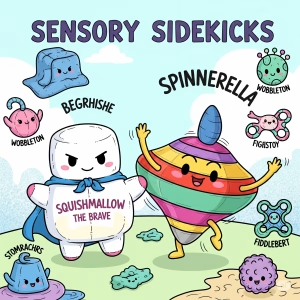
Let’s reframe these beloved objects as heroes in disguise:
Sidekick Name | Superpower | Sensory Survival Tool Type |
|---|---|---|
Squishmallow the Brave | Calms transitions and bedtime jitters | Tactile + Emotional |
Chewy the Wise | Oral input master, defender of focus | Oral + Emotional |
Spinnerella | Queen of vestibular calm and movement spells | Vestibular + Visual |
Scout the Steady | Audio rhythm regulator, sleep whisperer | Auditory + Emotional |
Want to go deeper into sensory-seeking behavior? The Truth About Sensory-Seeking Kids: How to Support Their Behavior is a must-read.
Is It a Toy or a Tool? (Mini Quiz)
 Is It a Toy or a Tool? (Mini Quiz)
If you’re wondering whether your child’s favorite object is a Sensory Survival Tool, ask yourself:
- Do they reach for it during transitions or stress?
- Does it help them focus, calm down, or fall asleep?
- Is it used repetitively (spinning, squeezing, chewing, pressing buttons)?
- Do they panic when it’s missing?
If you checked 3 or more, congratulations—you’ve got a Sensory Sidekick on your hands.
And if your mornings feel like meltdown mode before coffee, How to Recover When the Day Starts in Meltdown Mode might be your new lifeline.
What You Can Do Instead:
 What You Can Do Instead:
- Honor it. Let it be part of their toolkit.
- Observe it. What need is it meeting—touch, movement, oral input, sound?
- Support it. Offer similar tools if needed, but don’t rush the swap.
- Reframe it. Say, “This helps them regulate,” instead of “They’re obsessed.”
If your child regulates through sound, rhythm, or repetition, Signing Time offers gentle, engaging ways to build communication through music and movement. It’s more than language—it’s regulation in disguise.
Need help building a sensory-friendly morning? The Best Morning Routine for Kids with Sensory Processing Challenges has gentle, doable ideas.
Adult Reframe: What’s Your Sensory Survival Tool?
 Adult Reframe: What’s Your Sensory Survival Tool?
Let’s be honest—grown-ups have them too.
Coffee mugs, weighted blankets, playlists, gum, that one hoodie you wear when life feels hard.
Sensory needs don’t disappear with age. They just get rebranded.
Feeling overstimulated lately? Feeling Burned Out? A Survival Guide for Overstimulated Moms might be the hug-in-blog-form you didn’t know you needed.
Want to turn regulation into ritual? Art of Tea makes sensory-friendly tea time feel like a warm hug in a mug. It’s our go-to for calming transitions and cozy connection.
The Parenting Shift That Changes Everything
 The Parenting Shift That Changes Everything
This isn’t about letting go of boundaries—it’s about letting go of shame.
When we stop seeing sensory tools as distractions, we start seeing our kids as wise, resourceful, and deeply attuned to their own needs.
And honestly? That’s the kind of parenting shift that changes everything.
If your whole family feels sensitive lately, What Happens When Everyone’s Sensitive? A Real-Life Survival Guide to Highly Sensitive Parenting and Emotional Family Life might help you feel less alone.
Coming Soon: Sensory Wisdom in Disguise Series
 Coming Soon: Sensory Wisdom in Disguise Series
This post is part of a new series uncovering everyday regulation strategies hiding in plain sight.
Stay tuned for:
- Why pacing isn’t misbehavior—it’s movement regulation
- The magic of chewing gum and crunchy snacks
- How repetitive speech can be a calming loop
- Why lining up toys might be emotional architecture
And if you’re craving beauty and calm in your week, Turn Tea Time into a Weekly Ritual of Beauty: Art, Poetry & Music Made Simple is a gentle place to start.
Share the Reframe
 Share the Reframe
Next time you trip over that toy, pause.
It might be the very thing helping your child hold it together.
Share this post with a parent who needs the reminder: Regulation doesn’t always look like calm—it often looks like play.
Lindsey’s Picks: Gentle Tools for Real-Life Regulation
 Lindsey’s Picks: Gentle Tools for Real-Life Regulation
- Signing Time – Music, movement, and emotional connection for sensory-seeking kids
- My Pal Scout on Amazon – Nolan’s beloved auditory Sensory Survival Tool
- Art of Tea – Cozy blends for sensory rituals and parent self-care